
A Critical Analysis of the Actual CO₂ Balance of So-Called Renewable Energy
1. Introduction:
The term “green electricity” is used in today’s energy policy and public discourse as a synonym for climate-friendly, sustainable, and environmentally neutral energy. Electricity from sources such as the sun, wind, or water is described as “clean” and serves as a core argument in the energy transition. However, upon closer examination, this term is misleading. The generation, storage, and distribution of so-called green energy are inseparably linked to CO₂ emissions, environmental impacts, and the consumption of raw materials. This paper examines the thesis that there is no absolutely “green electricity,” but only electricity with varying emission intensities—meaning electricity that causes more or less CO₂, but never zero.
2. Definition of Terms and Theoretical Framework
2.1 Definition of “Green Electricity”
“Green electricity” is generally defined as electrical energy generated from renewable sources, in particular:
* Photovoltaics (solar energy)
* Wind power
* Hydropower
* Biomass
* Geothermal energy
The aim is to minimize environmental impact compared to fossil energy sources.
However, the official definition ignores upstream emissions—CO₂ emissions and energy consumption that occur before and during the construction of these facilities.
2.2 Systemic Perspective
In environmental accounting, this is referred to as a Life Cycle Assessment (LCA)—an analysis covering the entire life cycle of a product.
From this perspective, an electricity system would only be truly green if:
* its production,
* its operation,
* its maintenance and disposal
were nearly emission-free.
This is not the case for any technology in use today.
3. Analysis of Major Energy Sources
3.1 Photovoltaics
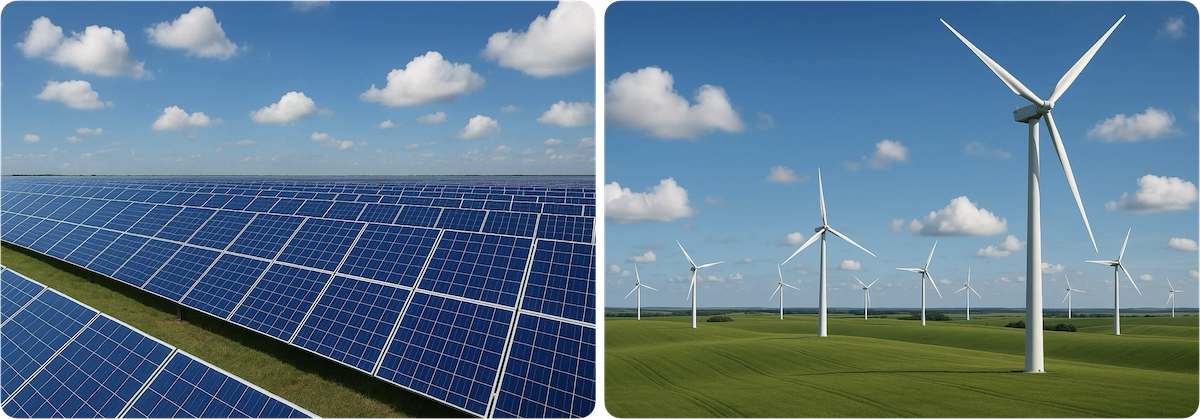
Solar power is considered a symbol of the green transition. However:
* The production of solar modules requires large quantities of silicon, which is melted at temperatures above 1,400 °C—usually using fossil energy.
* The extraction of quartz sand, silver, aluminum, and rare earth elements causes significant environmental damage and CO₂ emissions.
* Transport and installation of modules—often from China or Southeast Asia—typically rely on ship diesel and heavy fuel oil.
* After approximately 20–25 years, the modules must be replaced or recycled, which is an energy-intensive process.
Conclusion: Solar power is not CO₂-free; it is merely CO₂-reduced during operation.
3.2 Wind Energy
Wind turbines appear emission-free while operating. However:
* Manufacturing a single turbine (steel, concrete, fiberglass) produces 1,000–2,000 tons of CO₂.
* Concrete foundations often remain in the ground after dismantling—construction is the largest global source of CO₂ emissions.
* Maintenance and replacement parts require fossil-fuel-based transport.
* Disposal of rotor blades (mostly composite materials) is energy-intensive.
Conclusion: Wind power is “reduced-emission electricity,” but not “green” electricity.
3.3 Hydropower
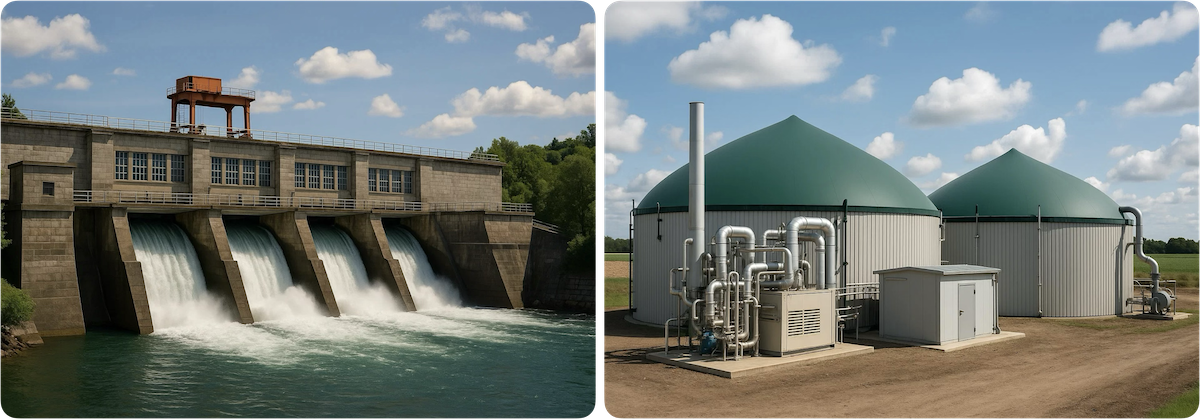
Often described as particularly clean—but:
* The construction of dams requires millions of tons of concrete.
* Cement production accounts for about 8% of global CO₂ emissions.
* Interventions in ecosystems (e.g., fish migration, sediment retention) cause irreversible damage.
* Tropical reservoirs emit methane—a greenhouse gas 25 times more potent than CO₂.
Conclusion: Hydropower shifts emissions into other ecological domains.
3.4 Comparison with Fossil Energy
Coal-fired power plants cause high emissions during operation, but the plants themselves are less resource-intensive to build.
Renewable energies partially reverse this relationship:
* High CO₂ input during construction,
* Low emissions during operation.
4. The Role of the Construction Industry
The construction industry is the world’s largest emitter of CO₂—over 35% of global emissions result from cement, steel, and building material production. Since every form of energy generation (including solar parks, wind turbines, dams, and grid infrastructure) must be built, “green electricity” is structurally impossible. Even maintenance and grid expansion (copper cables, transformers, batteries) rely on industrial processes far removed from climate neutrality.
5. Discussion: The Illusion of Zero Emissions
The concept of “net zero” or “green electricity” is based on shifting emission boundaries. Instead of actually avoiding emissions, they are often displaced: * to other countries (production), * to other sectors (construction industry), * or into the future (recycling requirements). This creates symbolic cleanliness, not physical cleanliness. In reality, there are only gradations: * Electricity with a high CO₂ footprint (e.g., coal, oil), * Electricity with a medium footprint (e.g., gas), * Electricity with a low footprint (e.g., wind, solar, hydropower). But electricity with zero emissions does not exist.
6. Conclusion
The term “green electricity” is linguistically, politically, and economically constructed—not physically real.
It serves to communicate a vision, not to describe an actual state.
From a scientific perspective, we should therefore speak not of “green electricity,” but of “emission-optimized electricity” or “CO₂-reduced electricity.”
The truth is: Every unit of electricity we generate has a history of energy consumption, resource extraction, and emissions.
The difference lies only in the magnitude, not in the existence of these emissions.
7. Recommendations for Politics and Industry
- Terminological honesty: The term “green electricity” should be replaced with “low-carbon electricity.”
- Holistic accounting: All forms of energy must be evaluated over their entire life cycle.
- Transparent labeling: Consumers should be able to see the actual CO₂ intensity (g CO₂/kWh).
- Industrial transformation: Decarbonizing the construction and raw-materials industries is a prerequisite for truly sustainable energy.
8. Closing Statement
“Green electricity” is not a physical reality, but a societal myth with political utility. As long as we generate electricity within an industrial civilization, every kilowatt-hour remains a product of energy, materials, and emissions. The task of the 21st century is not to search for green electricity, but to honestly state how much CO₂ each form of energy truly costs us.
Our thanks go to:

Interested in partnership, test facilities, or licensing? Send us a message – we'll get back to you quickly.